The Hollystic Approach™ to Education
Hollystic Approach™ to Education
Grounded in Human-Eyed AI™ and the belief that THEYCANBE?.!
The Hollystic Approach™ is a K–12 educational framework developed in collaboration with experienced educators and informed by real world practice across diverse school environments, system sizes, and program models. It is designed to help schools align learning, behavior, communication, and support in ways that reflect the realities of day to day classroom and organizational life.
At the core of the Hollystic Approach™ is Human-Eyed AI™, a philosophy that uses data, insight, and pattern recognition to inform decision making, while ensuring that professional judgment, human context, and relationships remain central. Technology is used to support understanding and clarity, not to replace educator expertise or student voice.
The guiding belief behind this work is THEYCANBE?.!
A reminder that students, educators, and systems are capable of growth, change, and multiple futures. The approach intentionally resists fixed labels, deficit thinking, and one size fits all solutions, instead creating space for possibility, agency, and evolving pathways.
Rather than prescribing a single program, the Hollystic Approach™ provides shared language, adaptable structures, and practical tools that schools can apply across classrooms, buildings, and districts. It supports consistency without rigidity and alignment without erasing local context.
Rooted in collaboration and lived experience, the Hollystic Approach™ emphasizes student voice, meaningful family partnership, and professional learning grounded in real work. It translates insight into action in ways that are practical, sustainable, and responsive to the needs of each school community.
The Hollystic Approach™ can be applied across multiple areas of K–12 practice, including conferences, communication systems, instructional reflection, collaborative planning, and program design. Its focus is clarity, care, and thoughtful alignment that supports the whole learning community.
© Hollystic Approach™. All rights reserved.
Human-Eyed AI™ and THEYCANBE?.! are trademarks of Hollystic Approach™.

Student-Centered Focus
Centers student voice, reflection, and agency so learning goals are shaped with students, not for them.

Collaborative Communication
Creates shared understanding through open, respectful dialogue among educators, families, and students.

Stress-Reducing Strategies
Supports calm, productive conversations, strategies, and resources by reducing pressure and creating conditions for psychological safety.
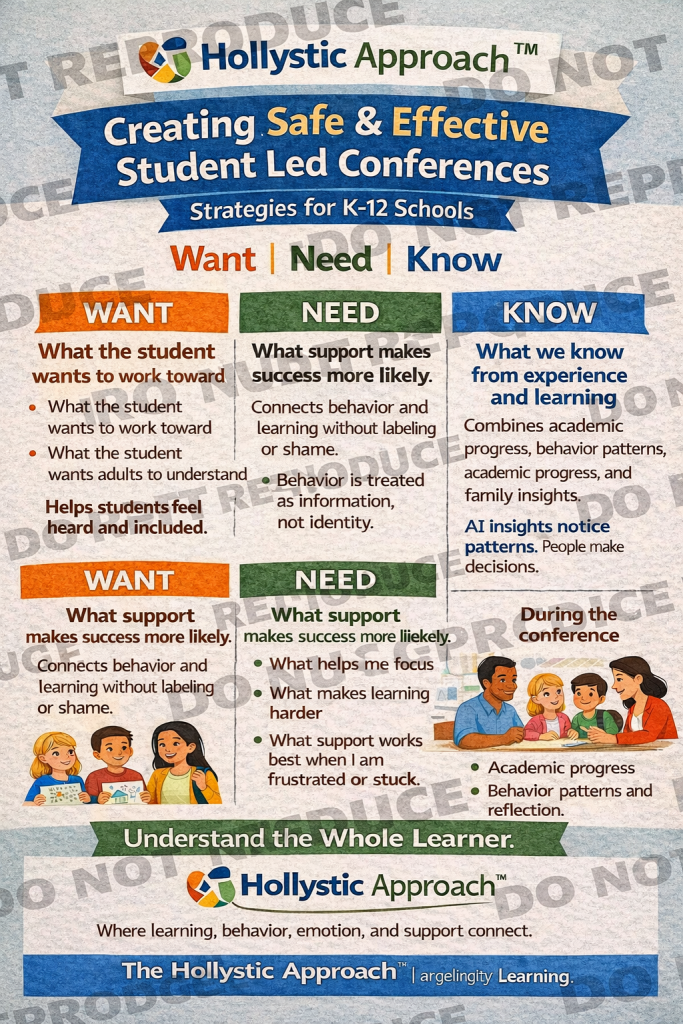
Hollystic Approach™ Student Conference Model
A schoolwide framework for implementing student led, family engaged conferences across K–12 classrooms.
The Hollystic Approach™ Student Conference Model is a building wide system designed to help schools implement student led conferences with clarity, consistency, and care. The model supports schools in preparing students, partnering with families, and facilitating meaningful conference experiences that center the whole learner.
Included are leadership guidance, staff and family communication templates, student preparation tools, and facilitation supports that make implementation practical and sustainable across classrooms and grade levels.
This model is designed for thoughtful rollout at the classroom, building, or district level and supports alignment without sacrificing professional judgment or student voice.
Licensed for use within one school building. Redistribution or reuse outside the licensed building is prohibited. District and multi building licenses are available.
© Hollystic Approach™. All rights reserved.
Hollystic Approach™Kit
Getting Started
• Core overview of the Hollystic Approach™ framework and guiding principles
• Introduction to Human-Eyed AI™, using insight and pattern recognition to inform decisions while keeping people at the center
• Shared language for aligning learning, behavior, communication, and support across K–12 settings
• Practical examples showing how the approach adapts across classrooms, buildings, and system sizes
• Entry points for implementation, including where to start small and how to scale intentionally
• Application examples across everyday school practices, including communication, reflection, and conferences
• Conversation and reflection prompts for educators, students, and families
• Guidance on maintaining flexibility while building consistency and trust
• Reflection tools to support continuous learning and improvement over time
$149 – Individual Educator License
Best for coaches, lead teachers, or consultants exploring the approach.
Includes:
• Personal use
• No redistribution
• Signals professional value without friction
$349 – Single School License (Recommended Core Offer)
This should be your primary offer.
Includes:
• Use within one school building
• Staff and classroom implementation
• Internal sharing within the building
This price feels reasonable to principals and instructional leaders and aligns with professional learning budgets.
Custom District Pricing Available
Positions this as strategic, not tactical.
Includes:
• Use across multiple buildings
• Leadership and planning use
• Entry point for broader rollout
You can also say: “Custom district pricing available.”
Student-Centered Focus
Empowers conferences that prioritize students’ voices and learning goals for meaningful engagement.
Collaborative Communication
Facilitates open dialogue among educators, families, and students to enhance understanding and support.
Stress-Reducing Strategies
Provides tools to ease conference anxiety, making conversations productive and positive for all.

Step One: Preparing for Conferences
Begin by equipping educators and families with tools to identify students’ wants, needs, and knowledge, laying the groundwork for productive conversations.

Step Two: Implementing the Model
Facilitate conferences using the Want • Need • Know approach, fostering open dialogue that enhances learning and behavior discussions.

Step Three: Enhancing Communication
Utilize this program to reduce stress and improve communication, ensuring conferences are collaborative and focused on student growth.